Switzerland · 8 min
When the Cows Come Home
June 26, 2026
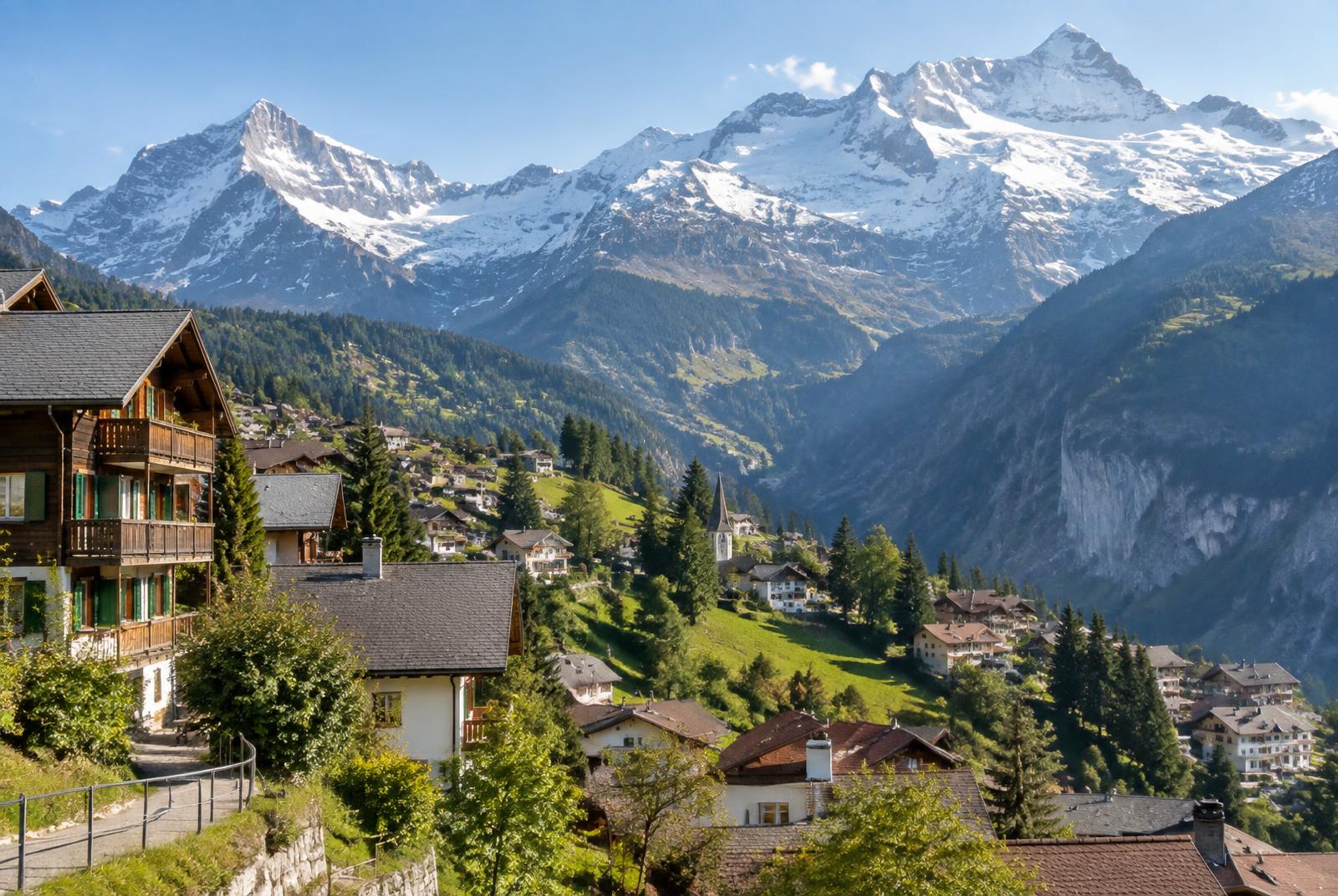
A love letter to Wengen, the car-free alpine village that changes how you measure time, and the art of doing nothing, perfectly.
There is an old English saying, “until the cows come home,” meaning forever. Or never. Or at least a very, very long time from now. It is used when you want to convey that something could go on indefinitely: I could wait here until the cows come home.
In Wengen, Switzerland, you will understand exactly why a cow’s homecoming became shorthand for eternity. Because here, in this car-free village perched above the Lauterbrunnen Valley with the Eiger, Mönch and Jungfrau filling every available inch of sky, time does something unusual. It slows. It thickens. It becomes something you can actually feel rather than merely measure.
The best thing you can do in Wengen is absolutely nothing, and you will be extraordinarily rewarded by doing it.
The valley that stops you cold. The journey in is part of the arrival. You reach Wengen by cogwheel train from Lauterbrunnen, climbing through forest and cliff as the valley floor drops away beneath you. No roads lead here. No cars intrude. When the train deposits you at the small station and you step out onto the platform, the silence, the enormous ringing alpine silence, is the first thing that hits.
Then you look up. And there they are: the great triumvirate of the Bernese Oberland. The Eiger’s brutal north face catching the morning light, the Mönch standing sentinel, and the Jungfrau, eternal in snow, presiding over everything with the serene indifference of something that has seen ten thousand winters and expects ten thousand more.
On the ground: the viewpoint bench above the village. There is a single bench above Wengen, a short flat walk from the main lane, that faces the full panorama of the three great peaks. Locals do not advertise it. You find it by wandering. Once found, it becomes your bench for the rest of the trip.
September, and the descent of the alp. If you are fortunate enough to visit in September, and I put fortunate with full intention, you may witness something that has repeated in these valleys for a thousand years: the Alpabzug, the autumn descent of the cattle from the high summer pastures.
When September turns and the first cold rides down from the peaks, the farmers drive their herds back through the valley. The cows are decorated for the occasion, flowers braided into their bridles, the largest and most celebrated cow wearing an elaborate ceremonial bell. They move through the village lanes with the unhurried authority of animals who know exactly where they are going.
The bells they carry, the iconic Swiss cowbells you thought were a tourist cliché until you hear fifty of them cascading across a valley floor, produce a sound genuinely unlike anything else. Deep and hollow and resonant, layered in bronze harmonics that seem to belong to the landscape itself. It is not background music. It is the music of the place.
The cows come home, and the Lauterbrunnen Valley marks the closing of summer with the only ceremony worthy of it: a slow procession, flowers in the hair, bells ringing off the cliffs, the whole valley pausing to watch.
The art of the alpine sit. I plan itineraries for people who love beauty and travel well. Not every client needs a packed schedule. Some, the wisest ones I have come to think, need exactly the opposite. They need permission to sit.
Wengen gives you this permission without being asked. Kleine Scheidegg, the ridge station at 2,061 meters where you step off the train and lunch on a terrace while the Eiger looms directly above, is less a restaurant than an altar. Mürren, the other great car-free village across the valley, exists at a height where clouds drift below the café windows. The valley floor walk from Lauterbrunnen to Trümmelbach, past honesty shops selling farmhouse cheese and past seventy-two waterfalls strung like pearls along the valley wall, takes an unhurried hour and costs nothing but your attention.
A Wengen long weekend, the slow version. Day one: arrive by cogwheel from Lauterbrunnen, walk the village lane, find the bench above the peaks, and dine on a terrace while the Eiger fades to alpenglow. Day two: Mürren for the clifftop panorama or Kleine Scheidegg for the mountain lunch, then the valley floor walk to Trümmelbach Falls, Europe’s largest underground glacier waterfalls. Easy and extraordinary. Day three: if skies are crystal clear, Jungfraujoch, the Top of Europe and the highest railway station on the continent; if clouds linger, take the train to Lucerne instead for the lake, the Chapel Bridge and the old town.
A September bonus: ask your hotel about the Alpabzug schedule. If the timing aligns, everything else can wait. The cows come home once a year.
What you carry home. Switzerland rewards the unhurried traveler above all others. Its greatest luxury is not its trains, though they are extraordinary, or its chocolate, though it is excellent, or its hotels, though those too. Its greatest luxury is the particular quality of its time, measured not in minutes but in the slow descent of alpine cattle through a valley that has been beautiful, and will be beautiful, for longer than any of us can comprehend.
You can wait here until the cows come home. In Wengen, that might be the most beautiful wait of your life.
Planning something along these lines?
Begin the conversation